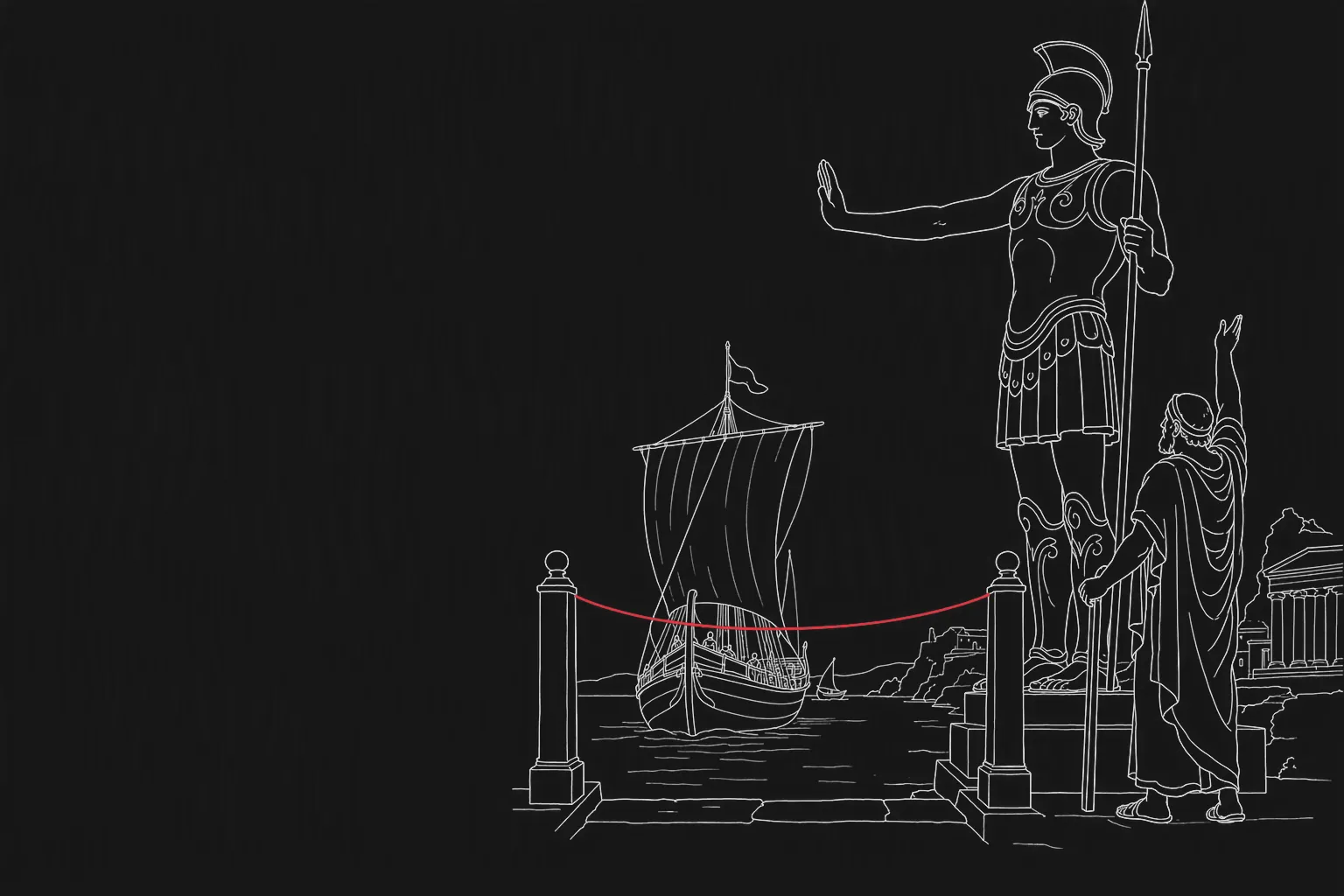
An agent is not a chatbot with ambition. It is software that acts on your behalf
The interesting part of agent engineering is not the model. It is deciding what the agent may touch, what it must ask about, what happens when it is unsure, and how anybody reconstructs a decision three weeks later. Those four questions separate an agent you can put in front of a process from a demonstration.
- An agent doing a real task end to end. One process, carried out against your real systems, not a scripted demonstration.
- Explicit bounds. What it may read, what it may change, up to what value, and what it must escalate — written down and enforced in code rather than in a prompt.
- A decision log. What it saw, what it concluded, what it did and who approved it. Kept permanently, readable by a person, and the reason the whole thing is defensible.
- A reduction path. A defined way to narrow what the agent may do unattended, which is the first response to anything going wrong.
What is delivered
Task and boundary definition
The task in operational terms, and the boundary around it: permitted actions, value limits, data it may see, and the cases that always go to a person.
Tool layer
The agent talks to your systems through explicit, typed, permissioned tools rather than through general access. This is where most of the safety comes from and most of the work goes.
Evaluation set
Real cases with known good answers, including the awkward ones, so a change can be judged rather than felt. Built before the agent, not after.
Approval and escalation
Where a person confirms, how the agent asks, and what a good escalation contains. Designed so that reviewing is fast, because slow review turns into rubber-stamping.
Observability
Decision logs, cost and latency per task, and monitoring built for a system that fails quietly rather than one that crashes.
Runbook
What to do when it is wrong: how to narrow its scope, how to roll back, and who is called. Written before it is needed.
How it runs
- 01
Scope one task
Narrow, high-volume, and with a checkable outcome. Broad agents fail in ways nobody can debug; narrow ones earn the right to grow.
- 02
Build the tools
The integrations and permissions first, agent behaviour second. An agent is only as good as what it can safely reach.
- 03
Evaluate honestly
Against the evaluation set including the exceptions, with the failure rate published rather than smoothed.
- 04
Ship behind approval
In production with a person confirming outbound actions, then widen the bounds as the evidence supports it.
A good fit when
- A high-volume task with a checkable outcome and clear rules of thumb.
- Work that currently requires reading unstructured input and preparing a structured action.
- You already tried a chatbot and found it could answer but not do.
- You need the audit trail as much as the automation.
Not the right service when
- The process is not defined and different people do it differently. Fix that first — automating an undefined process encodes one version of it at speed.
- The task is low-volume and high-consequence. A checklist is better and cheaper.
- You want autonomy without approval gates on irreversible actions. We will not build that.
Frequently asked questions
Which models do you use?
Can the agent act without a person?
What happens when it is confidently wrong?
How do you stop prompt injection and data leakage?
How long until something is running?
Keep reading
An agent on Android XR glasses is a four-part system
An on-device agent on Android XR spans the glasses, a host phone, the cloud and your own systems. Permissions, observability and upkeep have to cover all four.
The state your agents act on: Paimon between the database and the report
An operational agent needs current orders, stock and limits without polling the production database. How CDC, Flink and a Paimon table give it that state.
Ask an agent supplier for the decision log, not the demo
A demonstration shows an agent on its best day. The questions that separate a production supplier from a demo supplier are about bad days, logs and limits.
An agent is only as safe as the tools you gave it
Most attempts to make agents safe happen in the prompt. Almost all of the real safety comes from the tool layer, which is an engineering decision.
Retry the model, never the payment
Pipelines that mix models with ordinary systems retry constantly. Unless every step that changes state is idempotent and recorded, a retry becomes a duplicate.
Other services
AI Strategy
Which decisions are worth changing, what each would cost, and what would measurably be different. Including the ones where the answer is not AI.
Read articleAI Transformation
The part after the strategy: sequencing against real capacity, changing how work is done, and making adoption somebody's job rather than a hope.
Read articleAI-Native Apps Design
Designing software around a component that is fast, useful and sometimes wrong — which is a different design problem from anything before it.
Read article