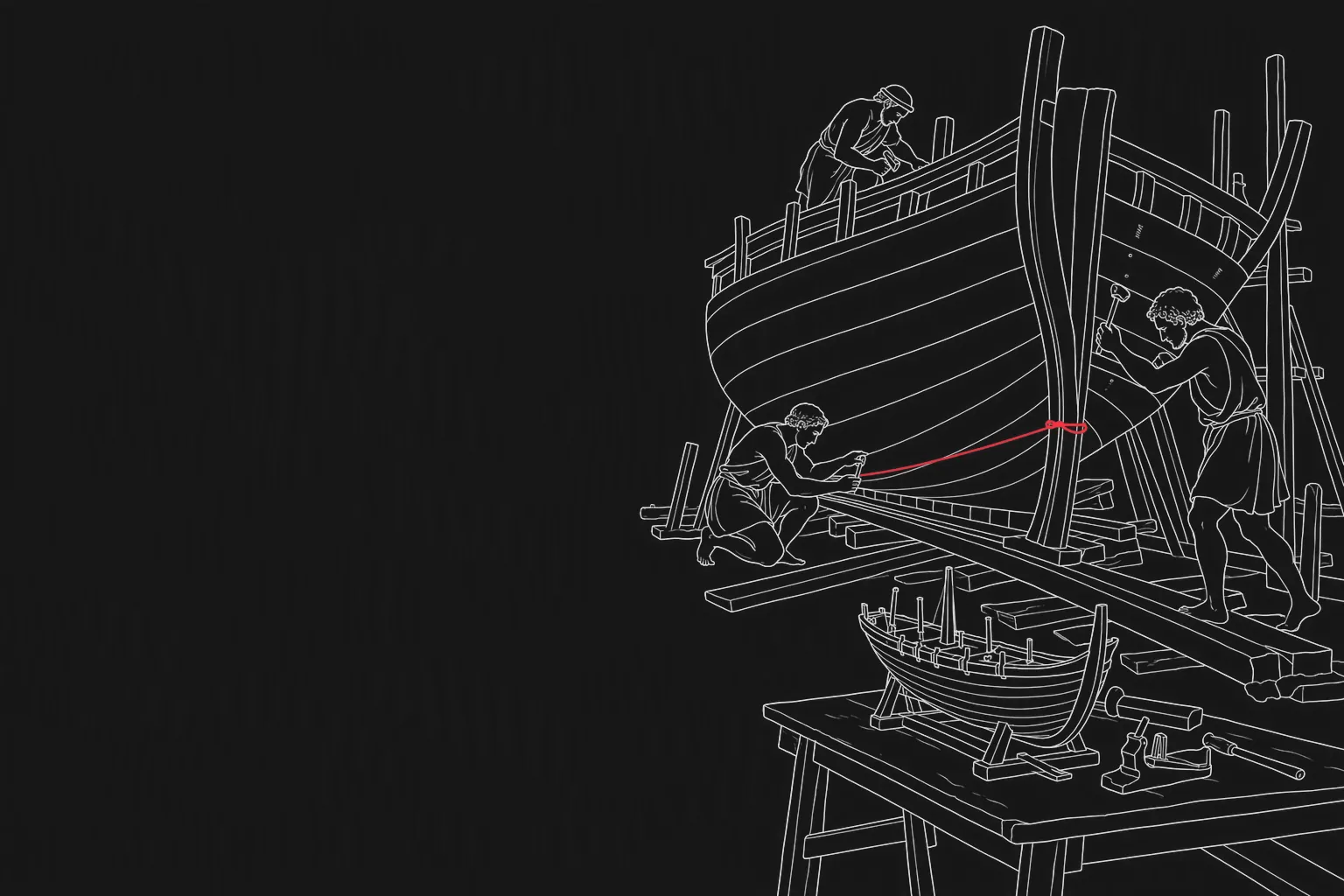
The demonstration took two weeks. The remaining nine tenths is this service
AI prototypes are unusually easy to build and unusually hard to finish. What separates them from a system is not model quality: it is evaluation, retrieval that actually finds the right thing, cost and latency inside a budget, permissions, failure behaviour, and the ability to change something without silently breaking it.
- Software in production against real data. With real permissions, real volumes and the exceptions that were absent from the demonstration.
- An evaluation harness. A test suite for a probabilistic system, so a change can be judged rather than felt, and a regression is caught before a user finds it.
- Cost and latency inside a budget. Measured per request and per task, with the levers documented rather than discovered during the first large invoice.
- Code you own. In your repositories, deployable by your team, with the model behind an interface so you are not married to one provider.
What is delivered
Evaluation harness
Real cases with known answers, scored automatically, run on every change. The single highest-value artefact in an AI codebase and the one most projects skip.
Retrieval that works
Chunking, indexing and ranking tuned against your actual documents, with retrieval quality measured separately from answer quality — because most bad answers are retrieval failures wearing a model costume.
Guardrails and validation
Structured output validation, refusal behaviour, injection resistance by architecture, and the rules about what must never be generated.
Cost and latency engineering
Model routing, caching, batching and prompt economy, with the numbers visible per feature so a product decision can account for them.
Observability
Traces, decision logs and quality metrics designed for a system that degrades quietly rather than crashing loudly.
Deployment and handover
CI, environments, secrets and runbooks on your infrastructure, documented well enough for your team to take it over.
How it runs
- 01
Harness first
Evaluation before features. Without it, every later change is a guess, and the project's speed collapses around month three.
- 02
Thin slice to production
One complete path end to end, deployed, in front of a small group. Everything unknown surfaces here and it surfaces cheaply.
- 03
Widen
More cases, more users, more automation, each step justified by what the evaluation shows rather than by the plan.
- 04
Hand over
Your engineers pairing throughout, documentation written during the work, and our involvement declining on a written schedule.
A good fit when
- A prototype works and nobody knows what it would take to make it real.
- An AI feature is live and its quality is unmeasured, so nobody dares change it.
- Costs or latency are unacceptable and the levers are not understood.
- You need the system on your own infrastructure with your own data rules.
Not the right service when
- The use case has not been validated with users. Build the prototype first — it is cheap and it answers a different question.
- You want a proof of concept for a board meeting. That is a legitimate purchase and it is not this.
- The data required does not exist yet. Data engineering comes first; no amount of application work compensates.
Frequently asked questions
Which stack do you build on?
How do you test something that is not deterministic?
How do you keep costs predictable?
Can you take over an existing codebase?
Do we get the code?
Keep reading
Operational databases and the lakehouse: the two memories of an AI-native system
An ERP database knows what is true now. Agents, models and audits need to know how it got there. Why an AI-native system needs a lakehouse beside SQL.
Before anyone builds your AI application, agree whose it will be
Ownership of an AI application is decided in the first week, not at handover. What to agree before the work starts, and the questions that reveal a hidden dependency.
Build the evaluation harness before the feature
Without a way to score changes, an AI codebase gets slower every month. Teams feel it around month three and usually blame the wrong thing.
A release is the code, the prompt, the model and the index
In an AI system, behaviour changes when the prompt, the model version or the retrieval index changes. Release and rollback have to treat them as one versioned unit.
The AI feature nobody dares to change
A live AI feature with unmeasured quality becomes a liability the day its model is retired or its bill grows. What taking it over involves, and what to expect from it.
Other services
AI Strategy
Which decisions are worth changing, what each would cost, and what would measurably be different. Including the ones where the answer is not AI.
Read articleAI Transformation
The part after the strategy: sequencing against real capacity, changing how work is done, and making adoption somebody's job rather than a hope.
Read articleAI Agents Engineering
Agents that do work rather than answer questions — with bounds, tools, approval gates and a decision log that survives the first incident.
Read article