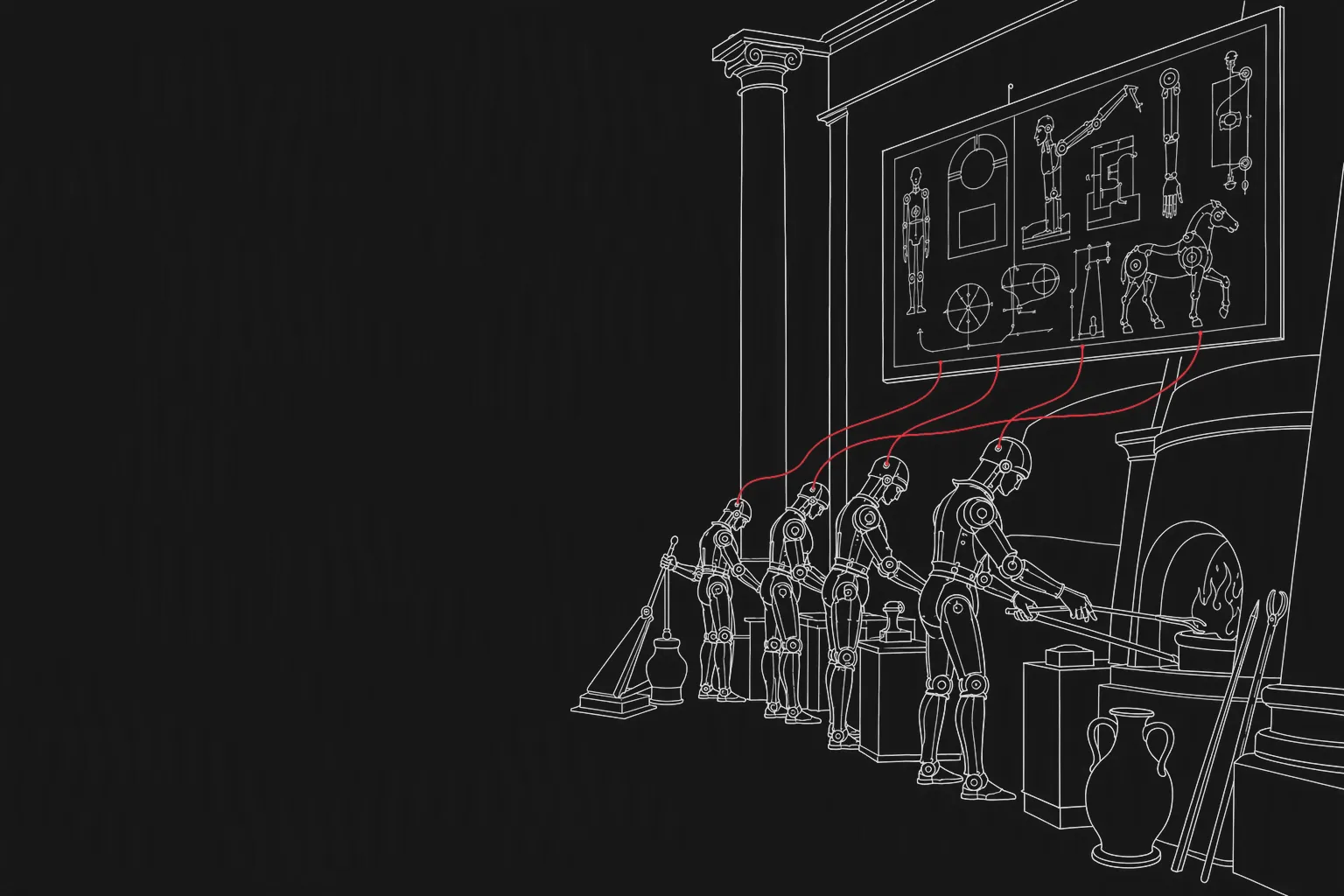
The lights go off. Everything the night shift knew has to be written down first
A dark factory is not a robotics problem — most plants already have the machines. It is a context problem. The night shift carries an enormous amount of undocumented knowledge about which machine drifts, which material behaves oddly and when to stop. Unattended operation means that knowledge has to exist somewhere a system can read.
- A machine-readable model of the operation. Equipment, materials, routes, constraints and tolerances in a form a system can reason over rather than in a manual.
- Exception handling defined in advance. What happens when something is out of tolerance, at three in the morning, with nobody there — decided while people are available to decide it.
- Provenance for every decision. What was observed, what was concluded and what was done, so the morning shift can reconstruct the night.
- An honest map of the boundary. What can genuinely run unattended and what cannot, which is usually a narrower set than the ambition.
What is delivered
Context model
Equipment, capabilities, materials, routings, tolerances and dependencies. The thing an unattended system reasons over, and the artefact this whole service exists to produce.
Tacit knowledge capture
Structured sessions with the shift teams to write down what they know: which machine drifts after a changeover, which supplier lot behaves differently, what a bad sound means. The hardest and most valuable part.
Exception taxonomy
Every deviation the operation actually sees, with a defined response: continue, hold, stop, escalate. Anything not on the list stops and calls somebody, by design.
Decision record
A permanent log of what happened overnight and why, readable by a person in the morning. Without it, unattended operation cannot be audited and therefore cannot be trusted.
Read-only integration
Signals from equipment, MES and quality systems. The context layer reads; it does not write to machines, and anything that actuates stays inside the safety case where it belongs.
Unattended-readiness assessment
Which parts of the operation are genuinely ready, which need instrumentation, and which should not run unattended at all. Frequently the most useful document.
How it runs
- 01
Watch a night shift
Literally. What people actually do between midnight and six is the specification, and it is almost never what the process documentation says.
- 02
Capture and model
The tacit knowledge into the context model, with the shift teams reviewing it. If they do not recognise it, it is wrong.
- 03
Run supervised
The system decides, a person confirms, for as long as it takes to compare its calls with theirs. The disagreements are the remaining work.
- 04
Narrow the supervision
Reduce human confirmation where the record supports it, one exception class at a time, with a defined route back.
A good fit when
- You already run automated production and want to extend unattended hours.
- Knowledge sits with a few experienced people and their retirement is a risk on somebody's register.
- Unattended runs have been tried and stopped too often to be economic.
- You need to demonstrate to an auditor or a customer how overnight decisions were made.
Not the right service when
- The plant is not instrumented. Sensing and data engineering come first — context over missing data is fiction.
- You want the system to control machines. We do not build inside the control path, and anyone who does should be able to show you the safety case.
- The real constraint is manual material handling. Automate that first; context will not move a pallet.
Frequently asked questions
Is this robotics or automation engineering?
Does the system control the line?
How do you get knowledge out of experienced operators?
What if the exception taxonomy is incomplete?
How long does this take?
Keep reading
How to judge a supplier who promises a lights-out plant
Lights-out proposals tend to lead with machines and models. The ones worth trusting lead with exceptions, read-only access and what should stay staffed.
Night-shift knowledge belongs on the risk register
In many plants the judgement that keeps production running sits with a few experienced people. Capturing it pays off whether or not the lights ever go out.
Where the automation stops, somebody has to start
In an automated process the exception path decides the result: what reaches a person, who that is when nobody is on shift, and how the decision gets back in.
The night shift knows things nobody wrote down
Unattended production is rarely blocked by robotics. It is blocked by the judgement three experienced people carry, which exists nowhere a system can read.
The business case for unattended hours is written in stoppages
Lights-out cases are usually built on machine capacity times hours. What decides the return is how often the operation halts with nobody there to restart it.
Other services
AI Strategy
Which decisions are worth changing, what each would cost, and what would measurably be different. Including the ones where the answer is not AI.
Read articleAI Transformation
The part after the strategy: sequencing against real capacity, changing how work is done, and making adoption somebody's job rather than a hope.
Read articleAI Agents Engineering
Agents that do work rather than answer questions — with bounds, tools, approval gates and a decision log that survives the first incident.
Read article