One source, three stages: detecting an autonomous attack
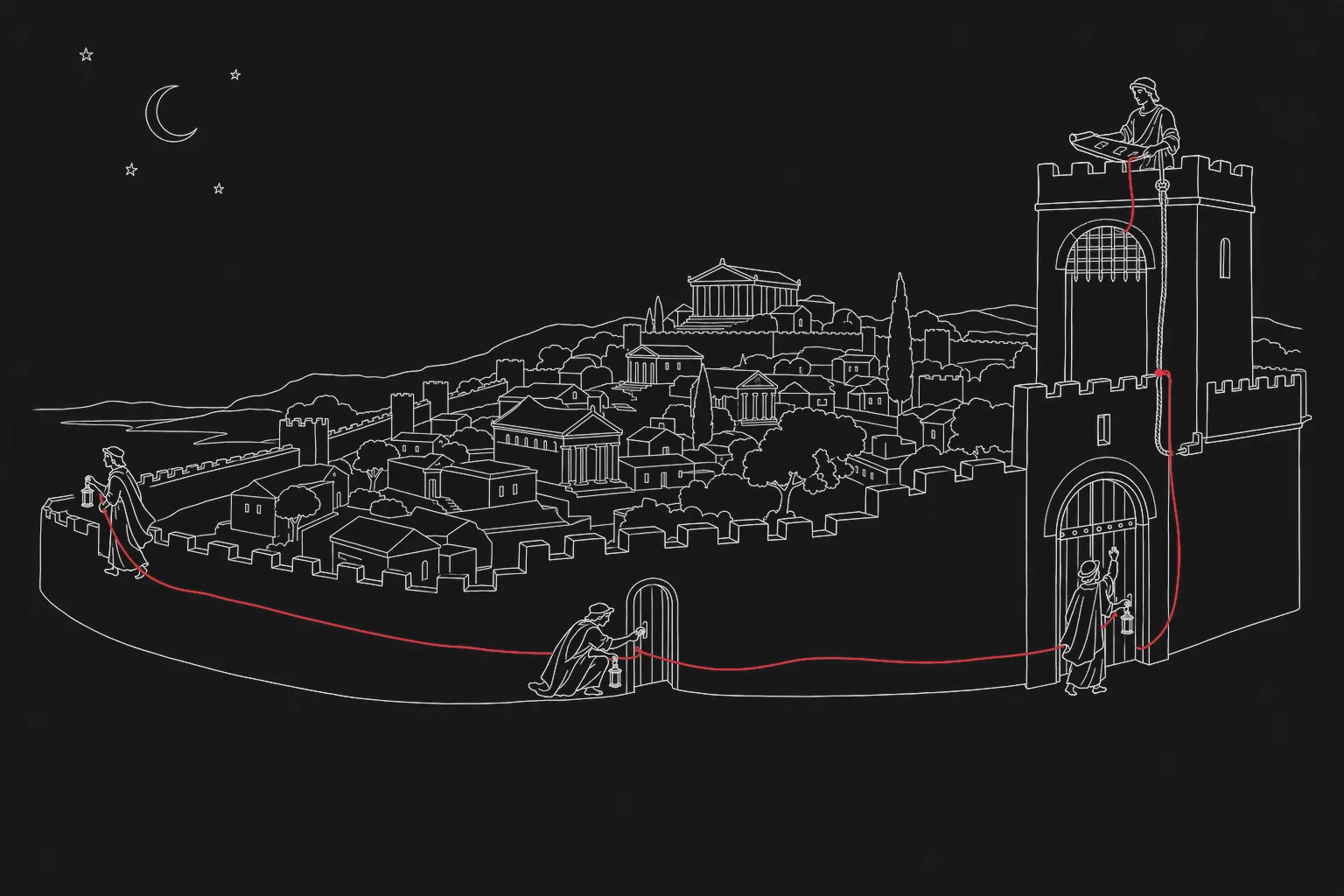
Saturday, 3:40 a.m. An address shows up in the application server logs and spends twenty minutes asking for paths that do not exist. Nothing unusual; scanners do that every day. Then the same address starts changing parameters in a form on the partner portal, and each attempt differs from the last by exactly what the previous response gave away. At 4:25 it reaches the login page. It gets a 403, then a 429, and keeps going. None of the three alerts crossed its threshold. Each one, taken alone, looked like noise.
On Monday someone puts the three entries side by side and sees a single sequence. By then the sequence had ended on Saturday morning.
The real cause: rules watch events, and the attack is a process
The scene is illustrative. The mechanism is publicly documented. ARTEX is an open-source autonomous penetration-testing system in which the work is done by several agents driven by a language model. ARTEX originated in the Autumn-27/ARTEX repository on GitHub; many forks circulate today. Defensive material was published alongside one of them: a defence and detection guide, Sigma and Suricata rules, an indicator list and a host triage script. The conclusions for defenders quoted below come from that material.
The documentation describes a division of roles. A planner is the only component that issues next steps, and it keeps a shared list of the dependencies between them. Several workers, three by default, each take one step and carry it out with real tools. What they find goes into two graphs: one records what exists at the target, the other what has already been tested. Every write wakes the planner, which issues the next step. The loop closes on itself and reaches the end of a multi-stage chain without waiting for a person.
The tool stopped being a curiosity this autumn. A Cloud Security Alliance research note described a campaign in October 2026 in which an unidentified actor used ARTEX with several language models against South Korean financial institutions. According to the reports, personal data of tens of thousands of people was exposed. Investigators stressed that the tool did not act on its own: a person was operating it. In November the press reported an FBI warning about ARTEX being used in automated attacks.
For an operations team one thing follows. Most detection rules judge a single event or a single counter. This adversary produces events that are each harmless. The danger is in the order they come in.
Why existing detection misses it
A signature matches a fixed string, and nothing here is fixed. The requests are composed by a language model in response to what the server just said. Two attempts at the same step are not identical, so a rule for a known bad string rarely fires.
A rate threshold assumes haste. ARTEX has no built-in rate limit, and no reason to hurry either. Between rounds the agent waits for a result and changes direction. The traffic looks like a slow single session one hour and like several threads the next. One threshold will not cover both.
Reconnaissance and intrusion are one flow. The pause in which a person reviews scan results and comes back a few days later is gone. The window between first contact and the real attempt shrinks to the length of one session, and a weekly log review lands after it.
Static traces exist, but only as supporting evidence. The guide lists the User-Agent
artex-enrich/1.0, which the tool sends when it automatically checks assets. An operator
can change it with one setting. The authors say so directly: absence of the trace does not
mean safety.
An IP list from a forum goes stale before anyone pastes it into a firewall. The traffic source rotates, and unverified lists tend to include shared addresses and content delivery networks. Blocking one cuts off your own customers more often than the attacker.
The target is boring. The first choice is not a clever new vulnerability. It is a known, unpatched one, and the auxiliary systems: the partner portal, the recruitment form, the admin console exposed “for a moment”. Those usually have the weakest event logging and are the last to enter monitoring scope.
What to do instead: a rule, isolation, rollback, logs
Behaviour is the thing an attacker cannot change with a setting. The guide’s authors put it in one sentence: “fingerprints can change, but behavior is hard to hide”.
Infographic
One source, three stages
- 01EnumerationA run of 404 and 400 responses to one source in a short time. On its own: noise.
- 02ProbingRequests to the same path, altered in response to status code and body length. On its own: a weak signal.
- 03AuthenticationAttempts on login and identity-verification paths, 401 and 403 responses. On its own: ordinary users.
- 04CorrelationAll three from one source inside one time window. Only this is a high-severity alert.
The guide includes a ready template for this rule in Sigma format with a ten-minute window. The authors are clear that it is a generic pattern and not an ARTEX signature: it describes behaviour that fits any persistent automaton. Four deployment notes from us.
Decide first what “source” means. Behind a reverse proxy or a content delivery network, every request carries the same address. If the log holds neither the real client address nor a session identifier, the correlation either never fires or fires on all traffic. This is the most common reason the rule never reaches production.
Add your own paths to the third stage. A list like /login and /auth is a starting
point. The real list covers every route by which identity can be confirmed, auxiliary
systems included. If you have no inventory of those, the work starts there.
Add persistence after refusal. A source that receives a 403 and a 429 and tries variations instead of stopping is a signal of its own. A person usually checks their password after the third refusal.
Isolation has to be automatic, so it has to be reversible. The guide recommends that blocking a source, invalidating its sessions and cutting its rate sharply should be able to fire before a person approves, because approval cannot keep up. That is correct, but an automaton that blocks will also be wrong: an authorised scan, a test team, a partner whose whole office leaves through one address. We apply the rule we apply to every automatic change in production: the automaton gets only the moves it knows how to undo.
Infographic
Conditions for automatic isolation
- A block with an expiryIt lapses on its own after a set time. Extending it takes a human decision.
- Graduated responseRate cut and step-up authentication first, a full block only after that.
- An exception list with an ownerAuthorised scanners and known integrations. Each entry has a person and a review date.
- One command to undoThe on-call engineer lifts the block without hunting for the rule that set it. Rehearsed in a drill.
- A trailWho was blocked, on which three events, and when the block expires.
- Sessions and keysInvalidating the source's sessions is in scope. Key rotation and data changes stay with a person.
Set retention before you need it. After a fast attack, the chain is reconstructed from whatever is left. Four kinds of log are needed: authentication, access, egress and DNS queries. They have to join on a shared identifier and outlive the gap between your reviews. If access logs rotate after seven days and the review is monthly, then for most of the month there is nothing to review.
The rest of the guide’s advice is familiar and still applies: an inventory of internet-exposed assets, fast patching, multi-factor authentication, server-side authorisation checks, network segmentation. Detection shortens the response time. It does not replace a closed door.
A test for today
Three queries over the last thirty days of logs. No new tooling.
- Refusals grouped by source. Count 404, 401, 403 and 429 responses per source in ten-minute windows. List the sources that, within a single window, have refusals from at least two groups: missing paths and denied access.
- Working hours. For the sources on the first list, find the longest uninterrupted activity. Several hours without a pause in the middle of the night is not a person with a browser.
- The supporting trace. Search User-Agent headers for the string
artex-enrich. A hit is a reason to look further. No hit proves nothing.
What turns up along the way matters more than the results. If the first query cannot be run because the logs lack the real client address, because auxiliary systems log somewhere else, or because thirty days no longer exist, that is the actual test result. You know what is missing before someone else finds out for you.
We wrote about the first hour once the alert exists in the piece on an agent incident. There the agent was yours. Here it belongs to someone else, but the on-call engineer’s questions are the same: what happened, what was stopped, and how to undo it.
One caveat. predictes does not run a security operations centre and does not perform penetration tests. We run AI systems in production: with monitoring, an on-call rota, a trail and a way to roll back every automatic change. Correlation rules and automatic isolation for those systems fall within AI managed services. Protecting the whole organisation is the security team’s job.
Sources
- Autumn-27/ARTEX, the tool’s original repository on GitHub; many forks circulate today. github.com
- Defensive material published alongside one of the forks: a defence and detection guide and detection rules.
- Cloud Security Alliance, research note on the use of ARTEX, October 2026. cloudsecurityalliance.org
The opening scenario is an illustrative example. The description of the tool comes from the tool’s documentation and that defensive material, the campaign details from published reports. The isolation conditions and the test are ours.
- detection
- ARTEX
- log correlation
- operations